Police: Subject Profile
This subject profile provides information on policing in Scotland.
Introduction
Since 1 April 2013, Scotland has had a single national police force – Police Scotland (also referred to, in legislation in particular, as the Police Service of Scotland). This is as a result of reforms provided for in the Police and Fire Reform (Scotland) Act 2012 (‘the 2012 Act’) which also:
established a single Scottish Police Authority (taking over many of the tasks formerly carried out at local authority level by police authorities and joint police boards)
created new police governance and funding arrangements
established the post of Police Investigations and Review Commissioner (taking over from the Police Complaints Commissioner for Scotland)
abolished a number of previous bodies including the eight territorial police forces (i.e. Strathclyde, Lothian & Borders, Grampian, Tayside, Fife, Central Scotland, Northern and Dumfries & Galloway).
For most policing purposes, Scotland has Police Scotland as its single national police force. This briefing therefore focusses on Police Scotland. However, there are a number of British or UK police bodies (falling under UK rather than Scottish jurisdiction) that also operate in Scotland. These include:
British Transport Police – police force for the railways providing a service for rail operators, their staff and passengers across Britain
Ministry of Defence Police – provides security within Ministry of Defence property across Britain (e.g. the nuclear submarine base at Faslane)
Civil Nuclear Constabulary – provides protection for nuclear materials on designated UK nuclear licensed sites and in transit
National Crime Agency – tackles serious organised crime across the UK including drug trafficking, modern slavery and human trafficking, cyber crime, money laundering and child sexual abuse and exploitation.
Police Scotland Structure
Police Scotland is comprised of 13 local policing divisions:
A Chief Superintendent is in charge of each local division. Policing at the local level includes response officers, community officers and those engaged in the investigation of offences. It also includes officers working on public protection and local intelligence.
These local policing divisions are supported by regional and national specialist resources, with local divisions grouped into the North, East and West Regions.
Examples of regional and national resources:
The Specialist Crime Division provides investigative and intelligence functions. It focusses on matters such as major crime investigation, public protection, organised crime and counter terrorism.
The Operational Support Division provides specialist support functions such as roads policing, firearms, public order, air support, marine policing, dogs and the mounted branch.
The Contact, Command and Control (C3) Division handles calls from the public. It has Area Control Rooms at several locations across the country.
In addition, there are corporate functions including people and development, finance and corporate communications.
Police Officers
The term ‘constable’ describes the office held by all police officers. It also refers to the starting rank of police officer. The other ranks are: Sergeant, Inspector, Chief Inspector, Superintendent, Chief Superintendent, Assistant Chief Constable, Deputy Chief Constable, and Chief Constable.
Police officers are represented by three police staff associations:
the Scottish Chief Police Officers Staff Association ('SCPOSA') which represents the most senior police officers - Assistant Chief Constable, Deputy Chief Constable, Chief Constable
the Association of Scottish Police Superintendents (‘ASPS’) which represents Superintendents and Chief Superintendents
the Scottish Police Federation (‘SPF’) which represents the vast majority of police officers - Constables, Sergeants, Inspectors and Chief Inspectors.
These associations perform roles similar to that of trade unions but police officers are prohibited by statute from being members of trade unions or from taking any form of industrial action.
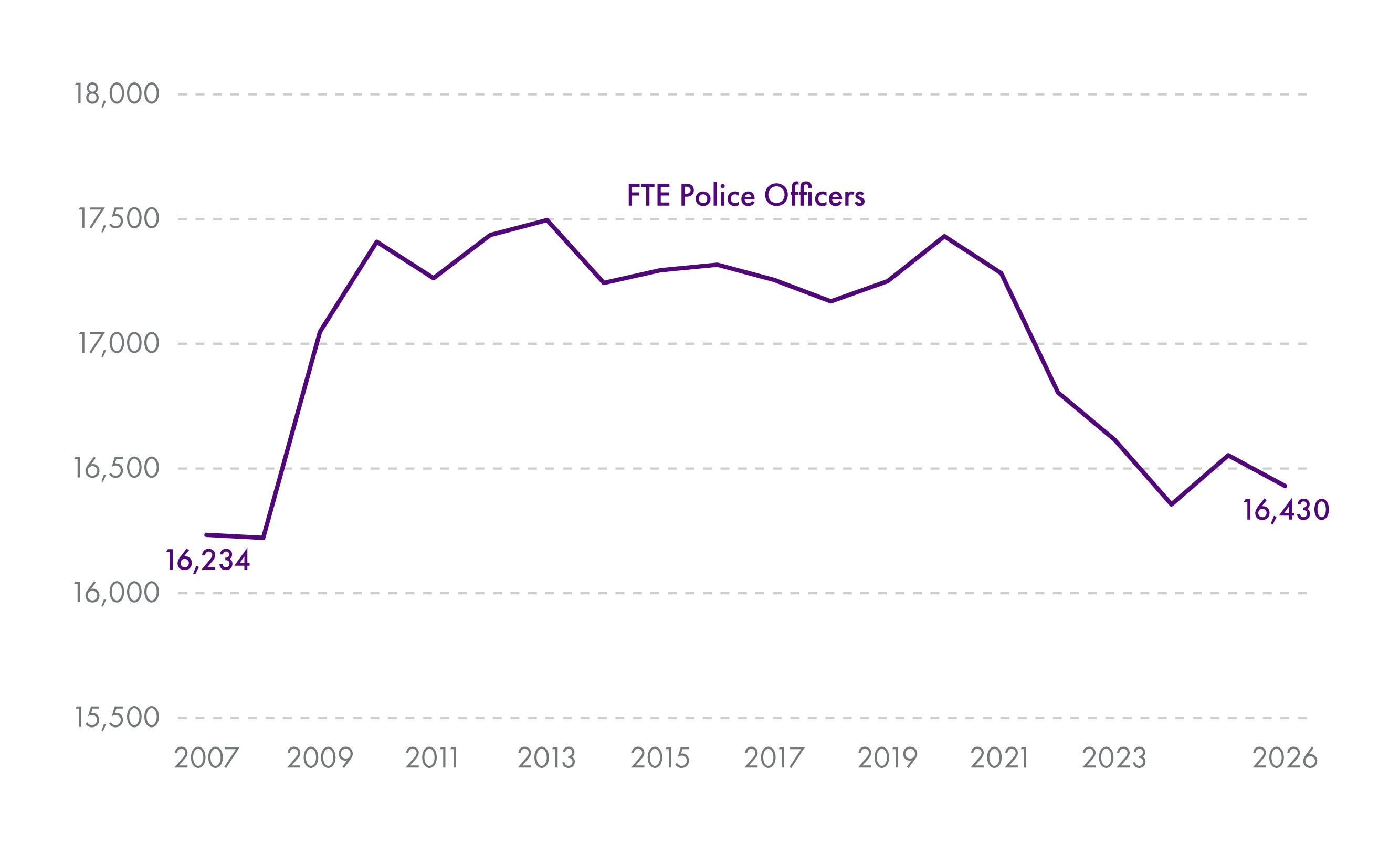
In 2007, the Scottish Government outlined a commitment to “make an additional 1,000 police officers available in our communities”.1 The figure as at 31 March 2012 (the day before Police Scotland was established) was 17,436 police officers (full-time equivalent posts).2 This represented an increase of 1,202 police officers compared with the position on 31 March 2007 (the baseline used for the commitment). The graph below shows the number of police officers as at 31 March each year from 2007. This number had been falling since 2020, though it increased between 2024 and 2025, from 16,356 to 16,553. The latest figures show a decrease to 16,430 FTE police officers, as at 31 March 2026.3
Scottish Government, Police Officer Quarterly Strength
With the budget allocation in 2023-24 representing a cut in real terms funding, Police Scotland stated that this would mean a reduction in their budgeted officer establishment figure from 17,234 to 16,600.4 In response to a parliamentary question (S6W-35556) on police officer numbers answered on 20 March 2025, Angela Constance MSP, then Cabinet Secretary for Justice and Home Affairs, stated that:
In 2023, Police Scotland restructuring led to a new establishment figure of around 16,500 to 16,600 officers.
The police also have part-time volunteer special constables. Whilst on duty, they have the same powers as other police officers. Although not paid a salary, the Scottish Ministers can make regulations allowing special constables to receive periodic payments in acknowledgement of their service. In 2011-12, prior to the creation of Police Scotland, the then eight territorial police forces had 1,456 special constables.5 As at 31 March 2024, there were 384 special constables serving with Police Scotland.6 In response to a parliamentary question (S6W-15163) on declining numbers of special constables answered on 6 March 2023, Keith Brown MSP, then Cabinet Secretary for Justice and Veterans, stated:
Statistics on Special Constable numbers and recruitment are a matter for the Chief Constable.
Whilst Police Scotland are actively recruiting they have in recent years focused their investment on fully trained Special Constables who are willing to deploy regularly and able to fully support officers in our communities.
Police support staff
In addition to police officers, civilian police support staff are used in a wide range of roles not requiring a police officer's power of arrest. These include areas such as:
custody and detention
analysis and performance
administration
human resources
communications and marketing
procurement
information technology
forensic services.
While not having the full powers of a police officer, civilian Police Custody and Security Officers (one category of police support staff) are conferred with some statutory powers and duties under section 28 of the 2012 Act.
Unlike police officers, civilian support staff can be members of trade unions and take industrial action.
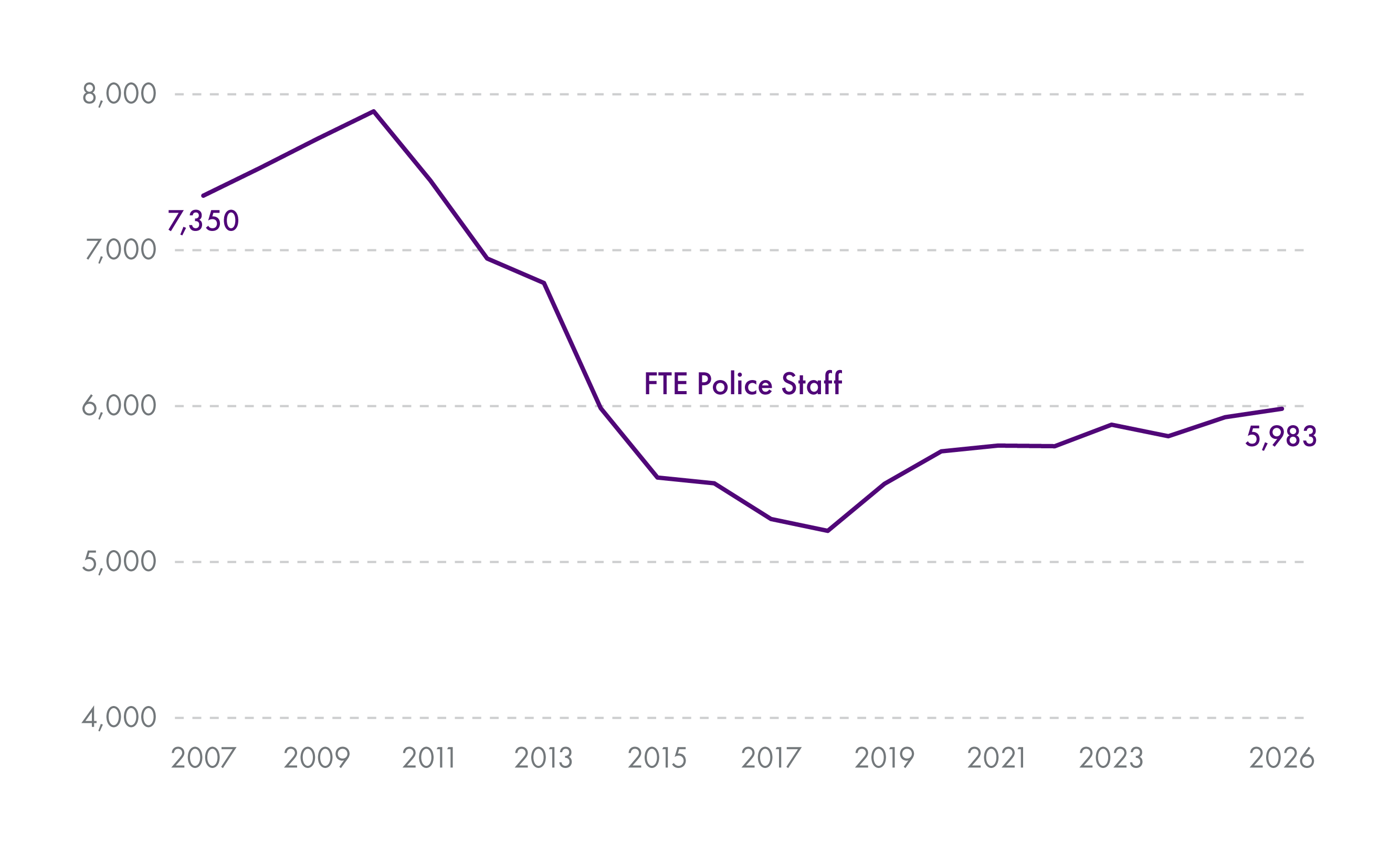
The number of police support staff (full-time equivalent posts (FTE)) was already beginning to fall prior to the creation of Police Scotland on 1 April 2013. Following the amalgamation of the eight legacy police forces under the Police and Fire Reform (Scotland) Act 2012, a voluntary redundancy and voluntary early retirement scheme was introduced and numbers of police staff fell significantly in the following years as this was implemented. One of the aims of creating a single police force was to allow for efficiency savings (see Scottish Government Policy Memorandum accompanying the Police and Fire Reform (Scotland) Bill). Graph 2 below shows the numbers of police staff (FTE) as at 31 March each year from 2007. The latest figures show Police Scotland have 5,983 FTE police staff as at 31 March 2026.1
Scottish Parliament - Parliamentary Question S5W-04676, Police Scotland - Police Scotland Office Numbers
Duties and powers
Section 20 of the 2012 Act sets out the general duties of police officers:
to prevent and detect crime
to maintain order
to protect life and property
to take lawful measures, and make such reports to the appropriate prosecutor, as may be needed to bring offenders with all due speed to justice
to serve and execute warrants, citations, etc.
to attend court to give evidence.
Section 50 of the Criminal Justice (Scotland) Act 2016 also requires police officers to take every precaution to ensure that people are not unreasonably or unnecessarily held in police custody.
Police officers have powers arising from both common and statutory law to carry out their duties, including powers of arrest and detention.
Section 10 of the 2012 Act provides that the appointment of a police officer is dependent upon the officer making the following declaration before a sheriff or justice of the peace:
I, do solemnly, sincerely and truly declare and affirm that I will faithfully discharge the duties of the office of constable with fairness, [candour], integrity, diligence and impartiality, [that I will follow the Code of Ethics for Policing in Scotland] and that I will uphold fundamental human rights and accord equal respect to all people, according to law.
Sections 2 and 3 of the Police (Ethics, Conduct and Scrutiny) (Scotland) Act 2025 inserted the words shown in square brackets into the declaration. Section 2 added the reference to the Code of Ethics, and required that the Chief Constable must prepare a Code of Ethics for Policing in Scotland. Section 3 added the reference to acting with candour. This, as well as references to "being open and truthful" and participating in proceedings "openly, promptly and professionally" was also added to the relevant police Conduct Regulations by this section.
Work of Police Scotland
Recorded crime in Scotland
The breakdown of different types of recorded crime and recorded offences in Scotland is set out in the tables below. For statistical purposes, a distinction is drawn between crime and offences, with "crime" constituting the more serious criminal conduct. Recorded Crime in Scotland, 2025-26shows that 315,357 crimes were recorded and 192,276 offences that year.
Overall recorded crime in 2025-26 was up by 5% since 2024-25 (from 299,111 crimes to 315,357). Over the past 10 years, total recorded crime in Scotland has increased by 6%. The overall clear up rate was 56.7%, similar to the 2024-25 figure of 56%.
Sexual crimes went up by 10% between 2024-25 and 2025-26 and have gone up 48% in the last 10 years. Recorded Crime in Scotland, 2025-26 stated that:
the issue of historical reporting of sexual crime also continues to play a role in the latest statistics. Further information from Police Scotland suggests that 26% of Sexual crimes in 2025-26 were recorded at least one year after they occurred.
It further stated:
The increase in sexual cyber-crimes has also had an impact on long term trends. We estimate that the volume of Sexual crimes that were cyber-crimes has increased from 1,100 in 2013-14, as recorded in Scottish Government research published in 2017, to 4,410 in 2025-26.
The Sexual Offences (Scotland) Act 2009 has also had an impact as it created new sexual offences, leading to an increase in the number recorded - for example, some behaviour that would previously have been recorded as breach of the peace or a miscellaneous offence is now recorded as a sexual offence under the 2009 Act.1
Cyber crime also appears to be increasing. This makes up 5% of total recorded crime (including 27% of recorded sexual crimes). The number of cyber crimes recorded was 14,200 in 2025-26, remaining similar to previous years since 2020-21 but significantly above the 2019-20 figure of 7,710. However, Recorded Crime in Scotland, 2020-21 indicates that this is impacted by changes to recording cyber crime in 2020. Before 1 April 2020, these statistics excluded any crime with a victim in Scotland and a perpetrator who was confirmed by the police to be outside the UK when the crime took place. Since that date these crimes are now included in the statistics.
| Type of crime | Proportion of overall recorded crime | Clear up rate |
|---|---|---|
| Crimes of dishonesty | 37% | 37% |
| Non-sexual crimes of violence | 24% | 69% |
| Crimes against society | 21% | 92% |
| Damage and reckless behaviour | 12% | 33% |
| Sexual crimes | 5% | 61% |
Overall recorded offences in 2025-26 was up by 9% since 2024-25 (from 175,979 offences to 192,276). In the last 10 years, the number of offences recorded by the police in Scotland has decreased by 16%.
The biggest change has been in relation to anti-social offences, which have decreased by 35% over the last 10 years (road traffic offences decreased by 8% and miscellaneous offences increased by 16%). In 2025-26, threatening and abusive behaviour accounted for 89% of anti-social offences. There has been a 20% decrease in offences constituted by threatening and abuse behaviour over the last 10 years.
| Type of offence | Proportion of overall recorded offences |
|---|---|
| Road traffic offences | 66% |
| Anti-social offences | 27% |
| Miscellaneous offences | 7% |
Police disposals
Police have the ability to to use police disposals for minor offences, rather than referring an individual to the Crown Office and Procurator Fiscal Service. In 2023-24 (the latest available figures), 30,490 police disposals were issued. This is a decrease of 3% from the previous year and a decrease of 43% since 2014-15.1
The most common form of police disposals are recorded police warnings (RPW). These accounted for 77% of police disposals in 2023-24. Anti-social behaviour fixed penalty notices (ASBFPNs) made up 14%.
The number of RPWs issued increased by 11% between 2022-23 and 2023-24. The number of ASBFPNs decreased by 13% over the same period and have decreased by 90% since 2014-15. This was "the largest driver of the overall decline in police disposals".1
In 2023-24, RPWs were mostly issued for drug possession (29%), threatening and abusive behaviour (25%) and common assault (15%). ASBFPNs were mostly issued for breach of the peace etc. (47%), consuming alcohol in a public place (25%) and urinating etc. (19%).
Governance and administration
Scottish Ministers, the Scottish Police Authority and the Chief Constable of Police Scotland all have roles to play in the governance and administration of policing. The Scottish Parliament has a role in providing scrutiny. The respective roles of each are set out below.
Scottish Ministers
The Scottish Ministers have overall responsibility for policing in Scotland. This role includes:
providing the Scottish Police Authority with the funds to resource Police Scotland and cover its own costs
setting strategic priorities for the Scottish Police Authority and approving its strategic police plan
holding the Scottish Police Authority to account for the delivery of effective policing.
Under section 48 of the 2012 Act, the Scottish Ministers must make regulations for the governance, administration and conditions of service of police officers.
Section 54 of the 2012 Act provides that the Scottish Ministers must consider any representations made by the Police Negotiating Board for Scotland before making regulations on police officers' pay, allowances, expenses, public holidays, leave and hours of duty.
Before making regulations under section 48 on any other matter, the Scottish Ministers must consult the Chief Constable, the Scottish Police Authority, the Scottish Police Federation, persons representative of senior officers and superintendents, and such other persons as they consider appropriate.
In taking forward their responsibilities, the Scottish Ministers are answerable to the Scottish Parliament.
Scottish Police Authority
The Scottish Police Authority (SPA) is a public body constituted by the 2012 Act. The SPA Board comprises up to 15 members who are appointed by the Scottish Ministers. The Board has delegated responsibility to a Chief Executive to provide support and advice on strategic decisions regarding various matters including finance and human resource.
The SPA has the ability to appoint its own staff and may also engage police officers on secondment. It is also able to borrow money with the consent of Scottish Ministers. Its responsibilities include:
promotion of the policing principles (as set out in section 32 of the 2012 Act) and continuous improvement in the policing of Scotland
preparation of a strategic policing plan (involving the Chief Constable)
provision of appropriate resources for Police Scotland (e.g. providing the Chief Constable with a budget to spend, buildings and equipment, as well as being directly responsible for the provision of forensic services to the police)
holding the Chief Constable to account for carrying out the responsibilities of the post (including the proper use of resources).
The SPA appoints all senior officers (see section 7 of the 2012 Act). It must appoint a Chief Constable as well as one or more Deputy Chief Constable and one or more Assistant Chief Constable. The appointment of the Chief Constable must be approved by the Scottish Ministers. The Chief Constable must be consulted before a Deputy or Assistant Chief Constable is appointed. The SPA can call on a senior officer (including the Chief Constable) to resign or retire from office in the interests of policing efficiency or effectiveness (see section 14 of the 2012 Act).
Chief Constable
The Chief Constable of Police Scotland is responsible for policing in Scotland with particular responsibilities including:
direction and control of police officers and civilian police staff
day-to-day administration of Police Scotland (including allocation and deployment of resources received from the Scottish Police Authority)
ensuring that all local authority areas have adequate arrangements for policing
designation of a local commander for each local authority area, with responsibilities relating to policing in that area
preparation of annual police plans
involvement in the preparation of the strategic police plan by the Scottish Police Authority.
The Chief Constable is supported by an executive team made up of Deputy Chief Constables, Assistant Chief Constables and Directors.
Scottish Parliament
Section 124 of the 2012 Act requires the Scottish Parliament to make arrangements for keeping the provisions of the 2012 Act under review and reporting on its operation.
The session 5 Justice Committee carried out a post-legislative review of the 2012 Act in 2018-19.
They published their report to Parliament in relation to Police Scotland on 25 March 2019.
Local Authorities
Since the 2012 Act, many of the tasks formerly carried out at local authority level by police authorities and joint police boards, including the setting of police budgets, now form part of the work of the Scottish Police Authority. Statutory police authorities and joint police boards ceased to exist under the new arrangements, but local authorities still have a role in local policing (e.g. monitoring local performance, working with local police commanders in setting local priorities and approving local police plans). Local authorities also retain the ability to provide additional funds for policing in their areas.
A Strategic Partnership Agreement for Policing has been agreed between COSLA, Police Scotland and the Scottish Police Authority. They have agreed four key priority areas to strengthen collaboration between local government and policing for 2022-2027:
local scrutiny and accountability
prevention and early intervention
health and wellbeing
resource and investment.
Strategic Framework
The strategic framework for policing encompasses the policing principles, strategic police priorities, three yearly annual strategic police plans, annual policing plans, together with policing plans at local authority and multi-member ward level.
Priorities and plans
Section 32 of the 2012 Act sets out the policing principles for Police Scotland. These are:
that the main purpose of policing is to improve the safety and well-being of persons, localities and communities in Scotland,
that the Police Service, working in collaboration with others where appropriate, should seek to achieve that main purpose by policing in a way which-
is accessible to, and engaged with, local communities, and
promotes measures to prevent crime, harm and disorder,
that the Police Service should be candid and co-operative in proceedings, including all investigations.
The Scottish Ministers and the Scottish Police Authority (SPA) are required to have regard to these principles when they are developing the strategic priorities and plans for Police Scotland. The Chief Constable must also have regard to these principles when directing constables.
As noted above, the Scottish Ministers may set strategic police priorities for the SPA – relating to policing and/or the carrying out of SPA functions. The latest strategic police priorities were published in January 20231. These were expected to remain in place for a period of three years ahead of the next full review consultation in 2025. However, it was subsequently confirmed that the Scottish Government would not revise the strategic police priorities in advance of the 2026 Scottish Parliament elections.
To support the strategic police priorities, the SPA, with involvement from the Chief Constable, develops Strategic Police Plans. Despite the strategic police priorities not being revised in 2025 as expected, a new Strategic Police Plan was still required under the 2012 Act. This covers the period 2026-2029.
The Chief Constable must produce an annual police plan for the period beginning 1 April. The latest Police Scotland Annual Police Plan 2026-27 was announced on 25 March 2026.
Local police commanders are responsible for putting in place local policing plans for each of the 32 local authority areas. These plans are available on Police Scotland's website under the heading of ‘Your Community’. These plans must, having regard to the Strategic Police Plan, set out the main priorities and objectives for the policing of the local authority's area. They should be in place for no longer than three years, with the current versions covering the period 2023-2026. A local police plan must be approved by the relevant local authority.
In September 2024, Police Scotland presented their 2030 Vision and related Three Year Business Plan. The 2030 Vision is focused on safer communities, less crime, supported victims, and a thriving workforce. It will be delivered over two three-year planning periods:
April 2024 to March 2027
April 2027 to March 2030.
The 2024-27 plan outlines more than 130 milestones Police Scotland aims to achieve by March 2027.
Scottish Policing Performance Framework
Prior to the creation of Police Scotland, the Scottish Government produced annual reports on the Scottish Policing Performance Framework from 2007 to assess how forces were performing.
This function was taken over by the SPA, and their Policing Performance Committee has oversight of this area. They scrutinise performance across a range of operational issues, strategic areas and statutory requirements. The annual review of the performance of policing is published in the performance section of the SPA Annual Report and Accounts, with the latest version found in the 2024-25 document 1.
Police funding
Funding for policing in Scotland is provided by the Scottish Government, subject to approval by the Scottish Parliament through the normal budget process. (As noted above, local authorities retain the ability to provide additional funds for policing in their areas.)
The main budget lines in this area are:
Scottish Police Authority – funding for the SPA and, through it, Police Scotland (allocated over £1.7 billion in the 2026-27 Scottish Budget)
Police Central Government – funding for police support services, the Police Investigations and Review Commissioner and national police funding and reform (allocated over £88 million in the 2026-27 Scottish Budget)
Police Pensions – funding to meet the pension costs of retired police officers (estimated cost of over £575 million in the 2026-27 Scottish Budget).
Most funding is provided to the Scottish Police Authority (SPA) to cover its own corporate costs, the costs for SPA Forensic Services and for Police Scotland. Police Scotland receives the majority of this funding - SPA's revenue outturn for the 2025-26 budget shows that Police Scotland spent £1,469.2 million compared with £48 million for SPA forensic services and £5.5 million for SPA corporate costs.
HM Inspectorate of Constabulary in Scotland
HM Inspectorate of Constabulary for Scotland (HMICS) provides independent scrutiny of both Police Scotland and the Scottish Police Authority (SPA). Its functions and governance arrangements are set out in Chapter 11 of the 2012 Act.
HMICS is staffed by a Chief Inspector of Constabulary, assistant chief inspectors and staff officers. Inspectors are appointed by His Majesty by an Order in Council, while staff officers are appointed by HMICS itself.
HMICS can carry out inquiries into the state, efficiency and effectiveness of the SPA and Police Scotland or into the arrangements the SPA and Chief Constable to secure best value. The Scottish Ministers may direct HMICS to inquire into specific matters.
HMICS is required to produce plans setting out priorities for inquires, including how these will be conducted, for example, see its Scrutiny Plan 2025- 20281.
Any HMICS reports are laid before the Scottish Parliament. The SPA and the Chief Constable must have regard to HMICS reports and take such measures as they think fit. If an inquiry finds that the SPA or Police Scotland is not efficient or effective or is not securing best value (or is unlikely to do so unless remedial action is taken), the Scottish Ministers may direct the SPA to take appropriate action to address the matter. The SPA must comply with any such direction.
Police complaints
The SPA, the Chief Constable of Police Scotland, the Police Investigations & Review Commissioner and the Crown Office & Procurator Fiscal Service are all involved in dealing with complaints about the police.
Section 34 of the Police, Public Order and Criminal Justice (Scotland) Act 2006 defines a relevant complaint as a statement (whether oral, written or electronic) expressing dissatisfaction about an act or omission (including standards of service provided) by any of the following:
the SPA
Police Scotland
police officers and SPA/police staff.
Complaints may be made by a person who was involved in an alleged act or omission, or who otherwise claims to have been adversely affected by or to have witnessed that act or omission. They may also be made by someone acting on behalf of such people. The Police (Ethics, Conduct and Scrutiny) (Scotland) Act 2025 clarified that this includes police officers and staff who can make a complaint in their personal capacity (i.e. when they are are off-duty).
For the purposes of these complaint procedures, relevant complaints do not include:
complaints about terms and conditions of a person's service with the police
complaints which include an allegation of an act or omission which constitutes a criminal offence (there are investigated as potential crimes)
complaints about an act or omission relating to, or adversely affecting, the person in their role as a constable or member of police staff (but complaints about acts or omissions relating to, or adversely affecting, that person in their capacity as a private citizen are relevant complaints).
Independent Review of Complaints Handling, Investigations and Misconduct Issues in Relation to Policing
In June 2018, the Scottish Government and the Lord Advocate jointly commissioned an independent review led by Dame Elish Angiolini (now Lady Angiolini) - the Independent Review of Complaints Handling, Investigations and Misconduct Issues in Relation to Policing ("the Angiolini Review").
The Angiolini Review began in September 2018, a Preliminary Report1was published in June 2019 and a Final Report2 in November 2020. There were 111 recommendations across both reports. They related to a range of organisations including Police Scotland, the SPA, the Police Investigations and Review Commissioner (PIRC) and the Crown Office and Procurator Fiscal Service (COPFS).
The recommendations which did not require legislative change were taken forward and their implementation overseen by the Complaints, Investigations and Misconduct in Policing: Ministerial Group. In March 2026, the co-chairs of the group, Angela Constance MSP, then Cabinet Secretary for Justice and Home Affairs, and Rt Hon Dorothy Bain KC, then Lord Advocate, wrote to the Criminal Justice Committee to confirm that all of the non-legislative policing recommendations were now complete.3
The recommendations which required legislative change were addressed by the Police (Ethics, Conduct and Scrutiny) (Scotland) Act 2025 (the 2025 Act) (but note that some of these recommendations require regulations to be implemented in full). The overarching policy objective of the Act was to ensure there were robust, clear and transparent mechanisms in place for investigating complaints, allegations of misconduct, or other issues of concern in relation to the conduct of police officers in Scotland.4
Scottish Police Authority
The Scottish Police Authority (SPA) deals with complaints relating to the business of the SPA as a public body, including complaints made about its Chief Executive, the SPA Board, individual members of the Board and SPA staff. Currently, it also deals with complaints and allegations of misconduct made against senior police officers (of the rank of Assistant Chief Constable and above) of Police Scotland.
However, when relevant sections of the 2025 Act are brought into force, the PIRC will carry out the initial assessment of allegations of misconduct for senior officers and an independent panel (rather than the SPA) will then determine misconduct cases for these officers. Complaints against senior officers (which do not amount to misconduct) and issues of performance for senior officers will continue to be dealt with by the SPA.
The SPA also provides oversight of how Police Scotland handles complaints and is responsible for ensuring that complaint handling arrangements are suitable.
Chief Constable
The Chief Constable is responsible for ensuring that suitable arrangements are in place for dealing with complaints against Police Scotland and its police officers. The Chief Constable is also responsible for ensuring that information on complaints is properly recorded and that information is provided to the SPA to enable it to assess the suitability of arrangements for handling complaints.
Police Investigations and Review Commissioner
The post of Police Investigations and Review Commissioner (PIRC) was established by the Police and Fire Reform (Scotland) Act 2012 , taking over from and expanding on the role and responsibilities of the former Police Complaints Commissioner for Scotland.
The Commissioner heads an independent organisation, not connected to the police, with a remit covering all police forces operating in Scotland and including the ability to investigate, on grounds of public interest, any matter relating to the SPA or Police Scotland.
The SPA and Police Scotland must refer certain serious incidents involving the police to the Commissioner for investigation. This includes the death or serious injury of someone in police custody or following contact with the police, or the use of firearms by police officers. The PIRC can also investigate allegations of misconduct by senior police officers (of the rank of Assistant Chief Constable and above).
Following recommendations contained in the Angiolini Review, all potential breaches of Article 3 (torture, inhuman or degrading treatment or punishment) and Article 5 (unlawful detention) of the European Convention on Human Rights (ECHR) where a crime may have been committed are now referred by the COPFS to the PIRC rather than Police Scotland to investigate1.
Members of the public can ask the Commissioner to review the way in which complaints have been dealt with by the police. Further information is set out in the Complaint Handling Review section of their website.
Currently, the PIRC is only able to review how the complaint was handled and not the complaint itself. Once the relevant section of the 2025 Act is in force this will change, enabling the PIRC to 'call-in' a complaint and investigate the complaint themselves.
The 2025 Act also introduced, or clarified, a range of powers for the PIRC, including allowing them to:
investigate allegations of criminality committed by a person serving with the police before they joined, during their time with, or after they have left, the relevant policing body - regardless of whether this criminality occurred when a police officer or member of police staff was on duty
audit the SPA and Chief Constable's arrangements for the investigation of information provided in whistleblowing complaints
be given direct access to Police Scotland's complaints database.
This Act also introduced powers for the PIRC that are not yet in force (as at 26 October 2026):
carrying out a complaint handling review without a request having to be made by the complainer, or by Police Scotland or the SPA, and requiring the SPA and Police Scotland to respond to any recommendations made by the PIRC
investigating serious incidents or allegations of criminality involving officers from other parts of the UK who are carrying out policing functions in Scotland
reviewing the practices and policies of Police Scotland and the SPA.
Crown Office and Procurator Fiscal Service
In general, complaints which allege that police officers or staff have done something amounting to a criminal offence are dealt with by the Criminal Allegations Against the Police Division (CAAPD) of the Crown Office and Procurator Fiscal Service (COPFS). However, the PIRC must, if directed to do so by the COPFS, investigate any circumstances in which there is an indication that a person serving with the police may have committed an offence.
Changes made by the 2025 Act mean that the COPFS are able to refer more cases of alleged criminality to the PIRC for investigation. The Act allows the COPFS to refer cases to the PIRC that relate to former officers. It will also allow them to refer cases relating to officers from other UK forces who are carrying out policing functions in Scotland once the relevant section is in force.
Sources
Scottish Government. (2007). Scottish Budget Spending Review 2007. Edinburgh: Scottish Government.
Scottish Government. (n.d.) Police Officer Quarterly Strength. Retrieved from <a href="https://statistics.gov.scot/data/police-officer-quarterly-strength" target="_blank">https://statistics.gov.scot/data/police-officer-quarterly-strength</a>
Scottish Government. (2024). Police officer quarterly strength statistics: 30 September 2024. Retrieved from <a href="https://www.gov.scot/publications/police-officer-quarterly-strength-statistics-30-september-2024/" target="_blank">https://www.gov.scot/publications/police-officer-quarterly-strength-statistics-30-september-2024/</a>
Police Scotland. (2023). Policing our communities. Retrieved from <a href="https://www.scotland.police.uk/what-s-happening/news/2023/august/policing-our-communities/" target="_blank">https://www.scotland.police.uk/what-s-happening/news/2023/august/policing-our-communities/</a>
Scottish Government. (2012). Scottish Policing Performance Framework – Annual Report 2011-12. Edinburgh: Scottish Government.
Police Scotland. (2024). FOI Request: 24-1398 - Special Constable stats - numbers/ hours worked - 2019 TD. Retrieved from <a href="https://www.scotland.police.uk/access-to-information/freedom-of-information/disclosure-log/disclosure-log-2024/july/24-1398-special-constable-stats-numbers-hours-worked-2019-td/" target="_blank">https://www.scotland.police.uk/access-to-information/freedom-of-information/disclosure-log/disclosure-log-2024/july/24-1398-special-constable-stats-numbers-hours-worked-2019-td/</a>
Police Scotland. (2024). Police Scotland Officer’s & Staff - Quarterly Fact Sheets - Quarter 3 – 30/09/2024. Retrieved from <a href="https://www.scotland.police.uk/about-us/how-we-do-it/police-scotland-officer-numbers/" target="_blank">https://www.scotland.police.uk/about-us/how-we-do-it/police-scotland-officer-numbers/</a>
Scottish Government. (2025). User Guide to Recorded Crime Statistics in Scotland. Retrieved from <a href="https://www.gov.scot/publications/user-guide-recorded-crime-statistics-scotland-5/" target="_blank">https://www.gov.scot/publications/user-guide-recorded-crime-statistics-scotland-5/</a>
Scottish Government. (2025, December 9). Criminal Proceedings in Scotland: 2023-2024. Retrieved from <a href="https://www.gov.scot/publications/criminal-proceedings-in-scotland-2023-24/pages/police-disposals/" target="_blank">https://www.gov.scot/publications/criminal-proceedings-in-scotland-2023-24/pages/police-disposals/</a>
Scottish Government. (2023). Strategic Police Priorities. Retrieved from <a href="https://www.gov.scot/binaries/content/documents/govscot/publications/strategy-plan/2023/01/strategic-police-priorities/documents/title/title/govscot%3Adocument/title.pdf" target="_blank">https://www.gov.scot/binaries/content/documents/govscot/publications/strategy-plan/2023/01/strategic-police-priorities/documents/title/title/govscot%3Adocument/title.pdf</a>
Scottish Police Authority. (2025). 2024-25 Annual Report and Accounts. Retrieved from <a href="https://www.spa.police.uk/publication-library/2024-25-annual-report-and-accounts/" target="_blank">https://www.spa.police.uk/publication-library/2024-25-annual-report-and-accounts/</a>
HM Inspectorate of Constabulary in Scotland. (2025). HMICS Scrutiny Plan 2025-28. Retrieved from <a href="https://www.hmics.scot/media/cbolhtqt/hmics-scrutiny-plan-2025-28.pdf" target="_blank">https://www.hmics.scot/media/cbolhtqt/hmics-scrutiny-plan-2025-28.pdf</a>
Angiolini, E. (2019). Policing - complaints handling, investigations and misconduct issues: independent review - preliminary report. Retrieved from <a href="https://www.gov.scot/publications/preliminary-report-independent-review-complaints-handling-investigations-misconduct-issues-relation-policing/" target="_blank">https://www.gov.scot/publications/preliminary-report-independent-review-complaints-handling-investigations-misconduct-issues-relation-policing/</a>
Angiolini, E. (2020). Independent Review of Complaints Handling, Investigations and Misconduct Issues in Relation to Policing - Final Report. Retrieved from <a href="https://www.gov.scot/publications/independent-review-complaints-handling-investigations-misconduct-issues-relation-policing/" target="_blank">https://www.gov.scot/publications/independent-review-complaints-handling-investigations-misconduct-issues-relation-policing/</a>
Policing: complaints handling, investigations and misconduct issues independent review. (2026, March 19). Retrieved from <a href="https://www.gov.scot/publications/policing-complaints-handling-investigations-and-misconduct-issues-independent-review/" target="_blank">https://www.gov.scot/publications/policing-complaints-handling-investigations-and-misconduct-issues-independent-review/</a>
Policy Memorandum. (2023, June 6). Retrieved from <a href="https://www.parliament.scot/-/media/files/legislation/bills/s6-bills/police-ethics-conduct-and-scrutiny-scotland-bill/policy-memorandum-accessible.pdf" target="_blank">https://www.parliament.scot/-/media/files/legislation/bills/s6-bills/police-ethics-conduct-and-scrutiny-scotland-bill/policy-memorandum-accessible.pdf</a>
Scottish Government. (2023). Complaints, investigations and misconduct in policing: implementation progress report. Retrieved from <a href="https://www.gov.scot/publications/complaints-investigations-misconduct-policing-implementation-recommendations-thematic-progress-report/pages/7/" target="_blank">https://www.gov.scot/publications/complaints-investigations-misconduct-policing-implementation-recommendations-thematic-progress-report/pages/7/</a>