Economy, Tourism and Energy Committee
Economy, Tourism and Energy Committee: Report on pre-budget scrutiny in advance of the of the draft 2027/28 budget
Introduction
Background
Establishment of the Committee
Following the start of Session 7 of the Scottish Parliament, the Economy, Tourism and Energy Committee ('the Committee') was established by the Parliament in June 2026. The remit of the Committee is—
To consider and report on matters within the responsibility of the Cabinet Secretary for Economy, Tourism and Transport, with the exception of transport, on matters relating to public infrastructure, civil contingencies and resilience, and on matters relating to energy and energy consents.
Budget scrutiny of the predecessor committees
During Session 6 of the Parliament, the elements of the Committee's current remit were divided amongst two predecessor committees. These were the Economy and Fair Work Committee (for economic and tourism policy) and the Net Zero, Energy and Transport Committee (for energy policy).
The Session 6 Economy and Fair Work Committee scrutinisedthe 2026/27 Scottish Budget, focusing on enterprise agencies, tourism and hospitality, women's enterprise, workforce skills, the Just Transition Fund, and Consumer Scotland. The Net Zero, Energy and Transport Committee focused its pre-budget report on the Scottish Government's Climate Change Plan, rather than on the bodies delivering energy policy.
Both committees highlighted key budget scrutiny findings in their legacy reportsi and suggested these should inform scrutiny work in Session 7. During its 2026/27 pre-budget scrutiny, the Economy and Fair Work Committee sought additional information from the then Deputy First Minister and Cabinet Secretary for Economy and Gaelic, Kate Forbes, to support its assessment of the draft budget with additional information
This included further information on data disaggregation, more granular data on NSETii Annual Reports, information on Scotland's workforce composition and measuring productivity, and information on the development of an AI Strategy for Scotland.
The information providediii by Ms Forbes built upon data the Session 6 committee had already sought and received during its scrutiny of the previous 2025/26 draft budget. That included more information on the "Scottish Government outturn figures and year on year comparisons, with specific reference to funding for the enterprise agencies". It also included information relating to employability. Further information was also provided on the Government's Digital Boost programme".iv
In its report on the 2025/26 Scottish Budget, the Session 6 committee stated that: "although not directly budget-related, we encourage the Scottish Government to ensure gender-disaggregated data on women's business activity and procurement in Scotland is gathered. This will be helpful when measuring outputs and disaggregation could also be considered more broadly."v
Recommendation
The Committee asks the Cabinet Secretary for Economy, Tourism and Transport and the Minister for Europe, External Affairs and Energy to provide the Committee with the same level of detailed information on the draft budget going forward as provided by the then Deputy First Minister in the Annex to her letter of January 2025.
Approach to budget scrutiny
On 8 September 2026 the Committee considered and agreed its approach to its pre-budget scrutiny of the draft 2027/28 Scottish budget.
As this is the first pre-budget scrutiny to be undertaken by the Committee since its establishment, the Committee decided to focus scrutiny on the main agencies relating to the economy and tourism under the remit of Stephen Flynn MSP, the Cabinet Secretary for Economy, Tourism and Transport (‘the Cabinet Secretary’), and on the heat and energy efficiency sector within the remit of Stephen Gethins MSP, the Minister for Europe, External Affairs and Energy (the Minister).
The draft Scottish Budget 2027/28 will be published by the Scottish Government on 3 December 2026. The Committee therefore agreed to take oral evidence from the Cabinet Secretary and the Minister in January 2027.
The Committee also undertook a public call for viewsi in advance of the 2027/28 budget. Information from the call for views will be used in conjunction with the written and oral evidence set out in this report to inform the session with the Cabinet Secretary and Minister in January.
Evidence taking
Written and oral evidence
At its meeting on 6 October 2026 the Committee took oral evidence from Stuart Black, Chief Executive of Highlands and Islands Enterprise, Adrian Gillespie, Chief Executive of Scottish Enterprise and Jane Morrison-Ross, Chief Executive of South of Scotland Enterprise. Highlands and Islands Enterprise, Scottish Enterprise and South of Scotland Enterprise also provided written submissions.
The Committee also took evidence from David Ritchie, Chief Executive and Jason McGibbon, Non-Executive Director of the Scottish National Investment Bank (SNIB), as well as receiving a written submission.
At its meeting on 27 October 2026 the Committee took oral evidence from Mike Thornton, Chief Executive of the Energy Saving Trust (EST), Cassandra Dove, Member of the Scottish Government's Heat in Buildings Strategic Advisory Group and Policy Lead at the Scottish Federation of Housing Associations (SFHA), and Ross Armstrong, Chief Executive of Warmworks. The EST, SFHA and Warmworks also provided written submissions.
The Committee concluded its oral evidence taking at that meeting by hearing from Vicki Miller, Chief Executive and Jamie Manson, Director of Corporate Services at VisitScotland, as well as receiving a written submission.
Enterprise agencies
Enterprise agencies: their role and funding
The Committee took evidence from the three enterprise agencies: Scottish Enterprise (SE), Highlands and Islands Enterprise (HIE) and South of Scotland Enterprise (SOSE). All three organisations play a key role in delivering the Scottish Government's economic priorities by seeking to grow Scotland's economy through increasing business productivity, investment, innovation, exports and high-quality employment, while supporting regional and inclusive economic development.i
Both HIE and SOSE have a dual mandate role as both have dedicated statutory responsibility to integrate community development with economic growth in their regions.ii
Enterprise agency witnesses emphasised the importance of their respective agencies as long-term investors in economic growth. They highlighted their role in supporting business growth, attracting private investment, developing workforce skills, improving productivity and delivering infrastructure that enables economic development.iii
The Committee also heard that all three agencies have been operating in a challenging fiscal environment for the last several years. All three agencies acknowledged the pressures facing Scotland's public finances, and the constraints created by the funding framework set out in the Scottish Spending Review 2026. However, they all pointed to concerns about funding constraints and the risks these could pose in undermining opportunities to grow the economy.
Current funding for enterprise agencies
The Scottish Government provides strategic direction to the enterprise agencies through annual guidancei and budget allocations. The Committee notes that budget allocations to the three agencies have fluctuated significantly over recent years, reflecting changing Government priorities, specific investment programmes and wider pressures on public finances. Final budget allocations for each enterprise agency over the last eight years are set out in Table 1.
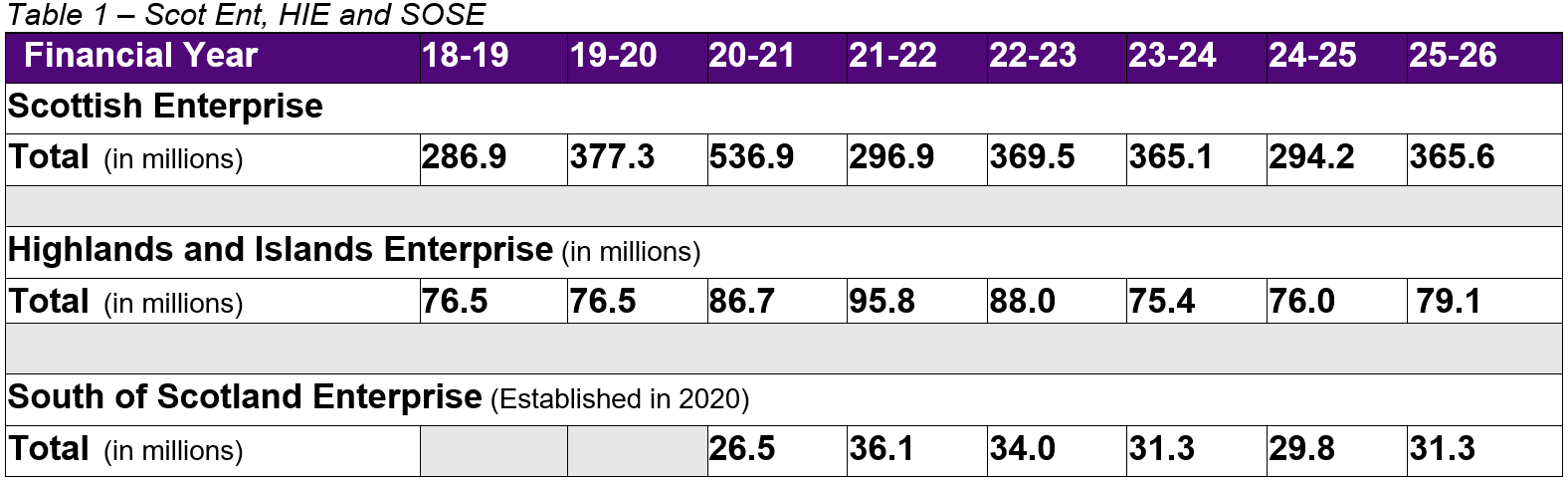
Although individual agencies have secured additional funding for specific projects and programmes, witnesses highlighted that inflationary pressures and rising operating costs continue to place pressure on available resources.
HIE told the Committee that its revenue budget had reduced over recent years in real terms and warned that any further reductions could increasingly restrict its ability to deliver economic interventions.ii Scottish Enterprise similarly highlighted the impact of sustained real-terms budget pressures,iii while SOSE noted that continued investment would be required if opportunities across the south of Scotland were to be converted into projects and jobs on the ground, pointing to the announcediv £32 billion pipeline of potential investment.v
Assessing the effectiveness of investments
Enterprise agency witnesses told the Committee that their expenditure should be viewed as an investment in Scotland's future economic performance rather than solely as a public expenditure cost.i
In addition to grant-in-aid funding from the Scottish Government, Scottish Enterprise highlighted that it had generated "£466 million of business income over the last five years". In 2025/26, the most recent year for which accounts are available, Scottish Enterprise generated "£64 million of business income (including for example income from investment activity, property disposals and rental income)." This, they stated, could be recycled into further economic development activity.ii
Members asked how the economic return from the public investment in the enterprise agencies can be effectively measured, and how that could be presented more clearly. In response the Committee was told that the evaluation frameworks are aligned with HM Treasury Green Book guidance iii and are subject to independent evaluation.i
Scottish Enterprise stated that its assessment methodologies show significant returns generated through investment activity, while HIE and SOSE emphasised the wider social and community benefits associated with economic development programmes, including employability, community resilience and reduced inequality. Adrian Gillespie told us—
We forecast our impact, but we also measure it. For example, the evaluation that the Scottish Government has done on trade and inward investment very much backs up our forecast impacts and underestimates them, if anything. When we talk about the £28 return that we make [for every £1 spent] over five years on our investments, that is very much backed up by best practice and by evaluation.i
Risks facing enterprise agencies
Multi-year funding
A consistent theme from the enterprise agencies was the importance of multi-year funding settlements. All three agencies argued that longer-term budget certainty would improve planning and allow them to maximise investment opportunities.
Enterprise agency witnesses stated that many economic development interventions require upfront investment over several years before benefits are realised, with Adrian Gillespie saying—
Sustained action over multiple years is required to create the conditions for companies to unlock investment, to scale up innovation and to create impact through internationalisation.i
The Committee was also told that annual funding cycles can inhibit long-term decision making and reduce the ability of agencies to respond quickly to emerging opportunities.i
Regional challenges
Evidence from HIE and SOSE highlighted the distinct challenges facing rural, island and south of Scotland communities.
HIE emphasised that population decline, workforce shortages and infrastructure constraints remain significant barriers to growth across parts of the Highlands and Islands. Addressing these challenges requires investment in housing, transport, digital connectivity, energy infrastructure and workforce development.i
SOSE similarly highlighted the importance of regional investment and referred to a substantial pipeline of potential projects across the south of Scotland. However, witnesses warned that opportunities may not translate into economic benefits without sustained investment and the ability to make decisions at a regional level, with Jane Morrison-Ross telling us—
Our ask of the committee is clear: champion sustained multiyear investment in the south, support greater regional decision making and back the infrastructure that is needed to turn opportunity into delivery. Give the south the tools to deliver, and we will deliver more for our communities, for our economy and for Scotland.i
Infrastructure investment
Infrastructure investment remains critical to supporting future economic growth the Committee was told. Enterprise agency witnesses argued that public sector investment often plays a catalytic role in unlocking wider economic activity and attracting additional private sector investment.
Scottish Enterprise warned that constrained capital budgets can make it more difficult to undertake the longer-term infrastructure investments necessary to improve productivity and competitiveness, such as in port development, energy network or workforce skills and training. Adrian Gillespie set out his concerns to us about constraints in capital budgets for the agencies—
In times of public sector constraints, it can be harder to make the economic case for longer-term infrastructure investment. That concerns me, because the investment that we have made in the SSE Hydro, in Gartcosh—Guala Closures is now investing there—and in the financial services district in Glasgow, the Dundee waterfront area and the port of Aberdeen, for example, is paid back over many years.i
HIE and SOSE also highlighted growing demand for regional specific support relating to other types of key infrastructural investment in areas such as housing, childcare, business innovation, digital adoption, artificial intelligence and decarbonisation.i
Evaluation of enterprise agencies
Members sought evidence on how enterprise agencies assess performance and demonstrate value for public investment. They expressed some frustrations at the level of detail provided by enterprise agencies in their annual reports and other publications which help to demonstrate key indicators of their performance.
The Committee heard that existing reporting and evaluation frameworks comply with statutory reporting requirements and accepted evaluation methodologies.i However, Members expressed concern that current reporting does not always provide sufficient clarity on outcomes, the extent of leveraged investment or the distinction between core public funding and other income sources.
The Committee also heard evidence that further work is underway to improve consistency and comparability between agencies. Enterprise agency witnesses acknowledged the need to develop clearer reporting frameworks and to provide greater transparency about the sources of funding supporting economic development activity.ii
SOSE highlighted the need to develop frameworks which capture information on the value of the more "intangible measures that are harder to quantify and that are not gross value added" such as "the impact on communities, child poverty, employability, satisfaction" and the "social impact their work makes on the ground".iii
Members also explored how agencies monitor outcomes for groups that have historically experienced barriers to employment, entrepreneurship or higher-paid work. Evidence highlighted activity targeted at women, younger people, minority communities and rural populations. However, the Committee considers that further information would assist parliamentary scrutiny of the impact of public investment across these groups.
Conclusions and recommendations- Enterprise agencies
The Committee is concerned that it could not thoroughly assess the value of the enterprise agencies' contribution to the economy with the information provided. As part of the annual reporting cycle, the agencies should provide further detail on how estimates of their economic impacts are calculated and evaluated, including the data sources and assumptions used to calculate these estimates.
The Committee accepts that enterprise agencies must comply with statutory reporting and accounting requirements, for example the guidelines set out in HM Treasury Green Book. However, we consider that greater transparency is required to support effective parliamentary scrutiny.
The Committee does not wish the agencies to face an unduly burdensome reporting regime. However, we are of the view that the additional information sought is available from the data they already collect. The Committee therefore recommends that the Scottish Government work with the enterprise agencies to develop more consistent reporting frameworks, which seek to provide clearer information on—
the level of public funding provided;
additional income and investment leveraged from other sources;
long-term economic outcomes generated by investment activity;
infrastructure investment supported through agency funding; and
outcomes achieved for key demographic groups, including women, young people, minority communities, rural, remote and island communities, those in low paid work and those experiencing economic disadvantage.
The Committee is concerned by the lack of transparency in how the enterprise agencies report their performance. Sufficiently detailed information is not presented in an accessible way to enable robust scrutiny of their effectiveness. This is particularly the case in relation to how enterprise agencies are contributing to progress on key priorities such as business growth, job creation, reducing the gender pay gap, and supporting rural and island economies.
The Committee calls on the enterprise agencies to work with the Scottish Government to review their performance monitoring and reporting arrangements. This should include consideration of a framework for the retrospective evaluation of high-value projects to assess whether anticipated economic and other outcomes have been delivered. Publishing this information as part of the agencies' annual reporting cycle would strengthen accountability and enable more effective scrutiny of performance and value for money.
Scottish National Investment Bank
Role and purpose of SNIB
The Committee took evidence from representatives of the Scottish National Investment Bank (SNIB). Established by the Parliament through the Scottish National Investment Bank Act 2020, it was set up to provide patient capital to businesses and projects across Scotland.i SNIB invests on commercial terms through debt, equity and fund investments and is intended to support Scotland's long-term economic development objectives.
Since its establishment, SNIB has committed over £1.2 billion to businesses and projects across Scotland and reports that this has helped mobilise a further £1.9 billion of public and private sector investment.ii
David Ritchie (CEO) set out the role of SNIB and what value it brings to the business landscape in Scotland—
…we focus more on the scale-up side of the business journey. We are also keen to look at how we can support businesses and projects that contribute to our missions. Our missions are how we support the transition to net zero, how we have a meaningful impact on place and how we can support the economy to become more productive.iii
The Committee also heard that SNIB's investment approach has evolved since its launch. While initially more focused on sectors such as life sciences and deep technology, SNIB now applies a broader approach to supporting growth businesses across a wider range of sectors where there is potential for expansion and long-term economic impact.iv
How SNIB is funded
SNIB is currently funded from the Scottish Government's annual budget. For 2026/27, SNIB received £190 million in capital funding through the Scottish Budget, as set out in Table 2. SNIB witnesses explained that this capital supports its investment programme and allows it to continue investing in businesses and projects aligned with its missions.

Unlike many public bodies, SNIB does not require resource funding from the Scottish Government to support its day-to-day operations. It told the Committee that investment income generated by SNIB now exceeds its operating costs, for the third consecutive year.i
The Committee recognises that SNIB occupies a distinct position within Scotland's economic landscape. Unlike enterprise agencies that provide grants and wider business support, SNIB operates as a commercial investor seeking both financial returns and long-term economic impact.
Application for PuFin status
A significant theme in the evidence was SNIB's ambition to secure recognition from HM Treasury as a UK Public Financial Institution, referred to as a PuFin.
PuFins provide nearly £200 billion in combined balance sheet capacity to crowd in private investment for infrastructure, clean energy, and business growth. The UK government is expanding PuFinsi to deploy massive capital for economic growth, clean energy, and infrastructure.
The Committee heard that obtaining PuFin status would represent an important step in SNIB’s development as a permanent national investment institution. SNIB stated that PuFin status would provide it greater flexibility to retain and recycle investment returns, reducing reliance on future Government capital allocations and strengthening its long-term financial sustainability.ii
SNIB witnesses described this as a key element of SNIB's long-term ambition to become a perpetual institution, able to finance future investments through the returns generated from its existing portfolio rather than relying primarily on periodic public capital injections.iii
The Committee heard that discussions between SNIB, the Scottish Government, HM Treasury and the UK Government are continuing, and that SNIB and the Scottish Government intend to submit a formal application for PuFin status before the end of 2026.iv
Effectiveness and losses
The Committee explored SNIB's performance and the way in which its impact is measured. Members heard about the "crowding-in" effect,i where public investment encourages additional investment from other sources. SNIB told the Committee that its investments have supported more than 3,000 jobs, delivered substantial supply-chain spending across Scotland and helped leverage additional public and private investment into the Scottish economy. SNIB witnesses argued that this ability to attract additional investment is one of its key strengths.ii
Members questioned whether SNIB's reported £1.9 billion of additional investment as a result of its activities is "genuinely additional new money" that would not have been invested without SNIB's investment. Responding, David Ritchie told us—
That is a good question. With every transaction and every asset that we have invested in, we always seek to understand from the business or the project lead what access they have to other finance. We are subject to subsidy control and state aid considerations, so we cannot crowd out other investors. When we have invested, there has always been a clear need and demand for bank capital. […] To give you a precise number, I will need to go away and speak to some colleagues [and respond to the Committee]. However, we are clear that, given the processes that we have to go through, we are not crowding out the private sector. We are doing the opposite and crowding in.iii
The Committee recognises the potential value of this approach but considers that greater clarity would assist parliamentary scrutiny. In particular, it would be helpful to understand how much of the reported £1.9 billion of additional investment can reasonably be regarded as investment that would not otherwise have occurred without the participation of SNIB.
In a letter to the Committee dated 2 November 2026, SNIB supplemented its evidence by saying it "defines crowd-in as capital mobilised alongside the Bank's investment, including private finance and other third-party capital invested alongside the Bank, and in subsequent investment rounds while the Bank remains invested in the company".
SNIB added that when considering the additionality of its investments it—
... seeks to assure itself that private capital is not available to support the opportunity, or that the opportunity would be developed significantly later without investment from the Bank. While [SNIB] notes that later development of a business or project would not be assured due to the inherent uncertainty in any opportunity's development, it is difficult to establish that it would not have done. Therefore, we have considered 'capital invested alongside the Bank' to be the most robust measure to track and report.iv
The Committee also discussed the unrealised losses reported within SNIB's investment portfolio. A recent review of the performance of SNIB by Sir John Elvidge examined the performance of the investments it had made since its establishment.v
Members questioned witnesses about this and the level of unrealised losses SNIB has reported in its 2026 annual report and accounts.vi In 2025/26, SNIB told us, it "recorded investment losses of £65 million and unrealised losses of £85 million".vii SNIB witnesses explained that such losses are an expected feature of development banking and patient-capital investing, particularly during the early years of an institution's operation.
SNIB noted that some losses reflect accounting requirements that require investments to be regularly revalued, particularly where businesses face commercial difficulties. SNIB further argued that early losses are often concentrated at the beginning of an investment cycle.viii
The Committee heard that SNIB has recently refined its investment strategy and is placing a greater emphasis on investing in more mature businesses and projects where appropriate, while continuing to support innovation and economic transformation.viii
Conclusions and recommendations - Scottish National Investment Bank
The Committee heard that achieving PuFin status has the potential to strengthen SNIB's financial independence, enhance its ability to recycle investment returns and support its development as a permanent institution within Scotland's investment landscape.
The Committee therefore asks the Scottish Government and SNIB to provide regular updates on progress towards obtaining PuFin status, including confirmation of when a formal application is submitted to HM Treasury and the anticipated timetable for consideration and a final decision.
The Committee welcomes the additional information SNIB provided in its letter of 2 November 2026 on "crowded-in" investment. However, the Committee also considers that greater transparency would assist scrutiny of SNIB's performance. In future reporting, SNIB should routinely provide additional detail on the nature of "crowded-in" investment and the extent to which such investment can be considered genuinely additional to funding that may otherwise have been available without SNIB's involvement.
Finally, the Committee heard that unrealised losses are an inherent feature of patient-capital investing. Nevertheless, SNIB's reported investment losses of £65 million and unrealised losses of £85 million in 2025/26 represent a substantial exposure of public funds and are, therefore, a matter of concern. Although we recognise the actions SNIB has identified to mitigate these risks, SNIB must provide greater transparency on portfolio performance, the factors driving losses, and the effectiveness of its risk-management arrangements. This information is essential to demonstrate that public investment is delivering value for money while supporting SNIB’s economic missions.
VisitScotland
Role and funding of VisitScotland
The Committee took evidence from VisitScotland witnesses on 27 October. As Scotland's national tourism and events organisation, VisitScotland plays a central role in promoting Scotland as a visitor destination, supporting regional tourism development and helping to grow the visitor economy.i
The Committee heard that VisitScotland currently invests around £40 million annually in activity intended to attract visitors, strengthen international connectivity and support sustainable tourism growth.ii In addition, the organisation administers the Rural Tourism Infrastructure Fund (RTIF), which received an additional £4 million in 2026/27.iii
Evidence provided to the Committee highlighted the significant contribution tourism makes to Scotland's economy. Tourism generates £11.4 billion of visitor spend annually, supports one in every 11 jobs, and events directly contribute £6.1 billion. Together tourism and events reach communities and supply chains across Scotland.i
VisitScotland activity delivered a combined £244 million net economic impact in 2024/25. Its marketing activity generated £1.3 billion in gross economic activity, with its marketing producing £73.5 million in net economic impact. VisitScotland states that each £1 invested in marketing generated £18 for the economy. Its supported events generated £147.1 million in net economic impact.i
Changes to VisitScotland's funding
The Committee heard that VisitScotland has experienced significant budget pressures in recent years. Total funding in the 2026/27 Scottish Budget was £52.2 million, representing a cash-terms reduction compared with the previous year and larger reductions in real terms, particularly in relation to capital funding.i
VisitScotland witnesses explained that these reductions have required the organisation to make substantial changes to both its workforce and operating model. VisitScotland told the Committee that it has sought to protect activity that directly supports economic growth while reducing expenditure elsewhere.ii
The Committee heard that a key objective of the organisation's restructuring programme has been to increase the proportion of funding directed towards economic development activity. VisitScotland stated that approximately 73 per cent of its core grant-in-aid is now spent on activities that directly support economic outcomes.iii
Changes to structure and delivery model
The Committee heard that the tourism sector has changed significantly in recent years, particularly in relation to how visitors plan, book and experience their trips.
VisitScotland explained that visitors increasingly make travel decisions before arriving in Scotland and are relying more on digital channels for information and trip planning. As a result, the organisation has adopted a more digital-first approach focused on influencing visitor behaviour earlier in the customer journey, encouraging visits throughout the year and promoting destinations across a wider geographic area.i
This change in approach has led to significant organisational restructuring, including the closure of the former iCentre network and a reduction in staffing levels. The Committee heard that 218 employees were affected by these changes, with a combination of voluntary redundancy, redeployment and natural attrition used to reshape the workforce.ii VisitScotland stated that retaining those posts would have added approximately £32 million in costs over a five-year period.iii
The Committee recognises that these changes have been driven both by financial pressures and by changing consumer behaviour. However, Members also explored how a more digital delivery model can continue to meet the needs of visitors and businesses, particularly in rural and island communities.
Rural tourism challenges
The Committee heard evidence on a number of challenges affecting rural tourism and visitor infrastructure.
VisitScotland emphasised the importance of ensuring that the benefits of tourism are spread across Scotland and that growth is managed in a sustainable way. VisitScotland witnesses highlighted the role of destination management, regional partnerships and infrastructure investment in supporting communities that experience seasonal visitor pressures.i
The Committee also heard evidence on the importance of self-catering accommodation to many rural and island economies, such as in Scottish Borders and Dumfries and Galloway. VisitScotland stated that available data suggests that, following short-term lets regulationii, accommodation provision in many rural areas has remained relatively stable, while acknowledging the need to continue monitoring trends and their potential impact on local economies.i
In relation to the RTIF, VisitScotland witnesses highlighted the benefits that greater flexibility in how funding can be used could have. The Committee heard about proposals for investment not only in traditional visitor infrastructure, such as toilets and car parks, but also in areas such as digital infrastructure and initiatives that support more sustainable travel. Setting out how the RTIF could be used more flexibly, Vicky Miller told us—
As part of our work, we have asked for flexibility to look at how we might invest in everything from, say, accessible toilets and car parks to motorhome, caravan and camping hook-ups because, after all, what is needed to improve infrastructure will vary around the country. We have also wanted to get ahead and look at where we might be more innovative in what we do and how we can use the fund to support. […] We do not have the funds to put in sustainable transport, but, through the visitor management steering group, the national parks have been doing some great pilot work on getting that modal shift and moving people on to buses and trains […] we are in the process of putting a paper to Government on the investment required to support all of the things that I have just outlined.iv
Reporting and evaluation of VisitScotland's effectiveness
A recurring theme in the evidence was how VisitScotland demonstrates the impact of public funding and the value generated by its activities, and the timeframes in which it publishes its annual reports.
Members noted that delays in the publication of annual reports can create challenges for parliamentary scrutiny, particularly when committees are undertaking budget scrutiny before the most recent reporting information becomes available.i
The Committee also sought greater clarity on how VisitScotland's expenditure is allocated between administration, staffing and economic development activity. VisitScotland witnesses explained that around £18 million of expenditure is directed towards non-staff activity, with the majority of operational resources focused on activities intended to support economic growth. VisitScotland accepted that it could provide clearer narrative information in future annual reports to explain these distinctions.ii
Furthermore, the Committee discussed performance measurement, key performance indicators and benchmarking indicators for VisitScotland. Members noted the recent observations made by Audit Scotland regarding the use of targets and comparative measures within VisitScotland's performance reporting—
VisitScotland uses a number of economic indicators to assess the impact of the various activities undertaken during the year. However, there are no targets or benchmarks included to assess whether performance was met, exceeded or was lower than expected.iii
In response, VisitScotland highlighted the work it has undertaken to strengthen its operational and strategic performance framework and the development of regular reporting against business plan objectives. Vicky Miller explained—
As for operational KPIs, we now produce for our board a quarterly report that is aligned with our business plan for the year. We have not only a three-year corporate plan but an annual business plan. The annual business plan includes a set of operational metrics from which I, the board and our leadership team can assess the ongoing performance of the organisation. We assess impact and outcomes each year using an economic measurement framework. We have an economist who does that, working alongside the office of the chief economic adviser in the Scottish Government.iv
While recognising this progress, the Committee considers that further improvements in transparency and performance reporting would strengthen accountability and assist parliamentary scrutiny.
Conclusions and recommendations - VisitScotland
Effective scrutiny depends on clear and timely reporting. The Committee therefore asks VisitScotland to ensure that annual reports are published as early as practicable to support parliamentary budget scrutiny.
The Committee further recommends that future VisitScotland annual reports should look to provide clearer information on—
the proportion of funding spent on economic development activity;
staffing, non-staff expenditure and core costs of the organisation;
activity expenditure and what it includes;
the outcomes achieved from public funding; and
the performance measures used to assess success.
The Committee welcomes VisitScotland's work to strengthen its performance framework and to address concerns regarding targets, benchmarks and key performance indicators.
Finally, the Committee asks the Scottish Government to give careful consideration to any forthcoming proposals developed by VisitScotland to increase flexibility within the Rural Tourism Infrastructure Fund, particularly where such proposals could improve visitor infrastructure, support local communities and contribute to sustainable tourism growth.
Heat and energy efficiency sector
Organisations, role and funding of schemes
On 27 October 2026 the Committee took evidence from representatives of the Energy Saving Trust (EST), the Scottish Federation of Housing Associations (SFHA) and Warmworks. Together, these organisations play a significant role in delivering Scottish Government policies on heat decarbonisation, energy efficiency and fuel poverty.
The Committee heard that EST delivers a range of programmes on behalf of the Scottish Government and Transport Scotland, including advice services, grants and loans. For 2026/27, EST estimated that approximately £30.3 million would be retained to deliver programmes and services, while a further £121.2 million would be administered and distributed through grants and loans to households, businesses and communities.i
The Committee also heard evidence from SFHA, which highlighted the role of housing associations in improving energy efficiency, reducing fuel poverty and supporting the transition to net-zero heating.ii
Meanwhile, Warmworks outlined its role in delivering the Warmer Homes Scotland scheme and a number of area-based energy efficiency programmes. Warmworks reported that the Warmer Homes Scotland programme is operating with a provisional budget of approximately £85 million in 2026/27.iii
The organisational witnesses agreed that the heat and energy efficiency sector is central to the delivery of the Scottish Government's climate change, energy efficiency and fuel poverty objectives. However, witnesses also highlighted a number of challenges affecting the effectiveness and pace of delivery across the key policy areas.
Changing policy background
A recurring theme to emerge from the evidence was uncertainty surrounding the future policy and regulatory frameworks for heat in buildings.
The Committee heard that the Scottish Government intends to publish a Heat in Buildings Strategy and Delivery Plan by the end of 2026. The Government has also committed to introducing a heat in buildings bill during the current parliamentary session.i
Based on information provided to the Parliament in April 2025 by the Scottish Government, the main focus of a bill would be to "set a new target for decarbonising heating systems by 2045 alongside continuing work to reduce fuel poverty".i It was stated at that time that the main provisions would include—
A target for decarbonising heating systems by 2045, sending a strong signal to homeowners, landlords and other building owners on the need to prepare for change while outlining collective actions to help do this.
Provisions to boost heat network development by developing requirements for large, non-domestic premises, including powers to require public sector buildings to connect to district heating when available.
Powers to set minimum energy efficiency standards for owner/occupier and non-domestic properties, subject to further consideration. Regulations will be progressed under existing powers to introduce a minimum energy efficiency standard in the private rented sector.
The Scottish Government subsequently published a draft Bill and explanatory notes in November 2025.
The organisational witnesses broadly welcomed the commitment to bring forward the new strategy, delivery plan and Bill, but argued that delays in key policy decisions have created uncertainty for delivery organisations, housing providers and property owners.iii
Particular concern was expressed regarding delays to future energy efficiency standards and the future requirements for different housing tenures. The Committee heard that uncertainty over future compliance standards has made it more difficult for organisations to prioritise investment decisions and develop long-term retrofit programmes.iv
Cassandra Dove of the SFHA highlighted that continued delays to works across the social housing sector stemmed from the delay to the publication of the revised Social Housing Net Zero Standard. She told us that the revised standards have been on hold for some time, but that Government has now made a commitment to finalise this by Spring 2027.v But, she stated, this delay has already created significant uncertainty for housing providers, with the result that retrofit programmes and investment decisions are being postponed. Cassandra Dove also argued that clarity on the final standard would unlock financial planning, enable landlords to commit to large-scale retrofit programmes and increase demand for the Social Housing Net Zero Heat Fund.vi
The Committee recognises that substantial public funding is being invested in heat and energy efficiency programmes. It therefore considers that timely policy certainty will be essential if the Scottish Government is to maximise the impact of that investment.
Cost of retrofit works
The Committee heard that the cost of decarbonising and improving Scotland's housing stock remains one of the most significant challenges facing the sector.
The organisational witnesses explained that the costs of retrofit vary considerably depending on the type, age and condition of the property and the measures required. The Committee was told that comprehensive retrofit projects under the Social Housing Net Zero Heat Fundi can cost around £50,000 per property, although witnesses emphasised that this reflects extensive programmes of improvement which could be considered the “gold standard retrofit” rather than a representation of the average intervention costs across Scotland’s housing stock.ii
The Committee recognises that a range of financial support mechanisms currently exist, including grants, loans and direct programme funding. However, the organisational witnesses noted that many schemes still require significant financial contributions from property owners or housing providers.iii
Evidence suggested that concerns around future costs, uncertainty over standards and the scale of upfront investment required can all act as barriers to participation.
The Committee also heard concerns regarding the longer-term affordability of some low-carbon technologies, such as heat pumps or heat-retention electric storage heaters. Witnesses noted that expectations that certain technologies would become cheaper and more efficient over time have not always materialised at the pace originally anticipated.iv
Members therefore explored whether current approaches provide sufficient assurance that consumers are receiving long-term value for money and are not being exposed to significant future maintenance and replacement costs.
Uptake and funding of schemes
The Committee also explored the apparent inconsistencies between evidence showing strong demand for some programmes and recurring underspends across parts of the wider heat and energy efficiency budget.
Evidence presented to the Committee showed that overall Scottish Government schemes have recorded spending below allocated budgets over recent years. At the same time, witnesses involved in frontline programme delivery reported strong levels of demand for the schemes they administer.i
In response to a Parliamentary Question about how expenditure had met the allocation across all the different upgrade funds, the Scottish Government responded that there had been an underspend in every year, for example in 2022/23, about £340 million was allocated but only £175 million was spent against it. In 2023/24, the allocation was £356 million and expenditure was only £249 million; and, in 2024/25, there was a £342 million allocation and £277 million of expenditure.ii
However, the EST told the Committee that it “spends all the budget that the Scottish Government allocates to it each year”, and Warmworks confirmed they “have not reported an underspend in 11 years".iii
The Committee was told that these apparent contradictions may reflect the differences between individual programmes. Some delivery bodies reported that available funding is fully utilised each year and that demand regularly exceeds available resources.iii Others highlighted structural challenges which can slow project development and reduce annual expenditure against budget allocations.v
As touched on earlier, the organisational witnesses suggested that delays in policy decisions, uncertainty around future standards and the complexity of large-scale retrofit projects may all contribute to slower spending in some programmes. Housing providers, in particular, indicated that uncertainty can delay decisions to proceed with major investment projects.
The Committee also explored public engagement and uptake of support schemes. Witnesses highlighted the challenge of increasing awareness while managing finite programme budgets. Simplifying the customer journey and providing clear advice were identified as important factors in encouraging participation.vi
Members additionally considered evidence comparing Scotland's support schemes with equivalent programmes elsewhere in the UK. Witnesses suggested that differences in delivery models may influence various uptake rates.vii While some schemes prioritise consumer advice and independent assessment, others place greater emphasis on installer-led delivery. The Committee heard differing views regarding the relative merits of these approaches.
Overall, the Committee considers that further work is required to understand whether current funding arrangements are delivering investment as effectively as possible and whether barriers remain that are preventing households and organisations from accessing support.
Supply chains, including rural, remote and island communities
The Committee heard that the long-term success of heat and energy efficiency programmes depends on maintaining resilient supply chains, skilled workforces and sufficient delivery capacity across Scotland.
Witnesses emphasised the importance of long-term programme funding in providing confidence for businesses to invest in staff, training and equipment. Warmworks pointed to the stability created by long-running programmes such as Warmer Homes Scotland, arguing that funding certainty enables contractors to expand capacity and invest in future growth.i
The Committee also explored challenges affecting rural, remote and island communities. Witnesses described how geography, weather conditions, transport costs and access to specialist contractors can increase the complexity and cost of delivering retrofit projects in some areas.ii
Despite these challenges, the Committee heard evidence that long-term investment has helped build “an infrastructure of people and [local] expertise” and delivery capacity in many rural and island communities. The organisational witnesses highlighted examples of locally based contractors participating successfully in delivery programmes and contributing to local economic development.iii
Members nevertheless expressed concern about whether smaller and local suppliers are consistently able to access opportunities within existing delivery arrangements.iv The Committee considers it important that procurement and delivery models support competition, local participation and the development of regional supply chains wherever possible.
The Committee also heard that consideration must be given to the long-term maintenance and replacement of low-carbon technologies, particularly in remote communities where access to specialist skills and servicing may be more limited.v
Conclusions and Recommendations - Heat and energy efficiency sector]
The evidence received by the Committee highlights the complexity of Scotland's heat and energy efficiency policy landscape. Multiple schemes are in place to deliver a range of objectives, including improving the energy efficiency of existing homes, supporting the transition to net zero, and tackling fuel poverty. The Committee is concerned that this fragmented landscape risks creating confusion and may hinder the effective delivery and evaluation of policy outcomes.
The Committee heard that uncertainty regarding future energy efficiency standards, legislation and funding arrangements may reduce the effectiveness of current programmes. This may inadvertently slow the decision making process by households and housing providers when deciding to make an investment in energy efficiency.
The Committee therefore recommends that the Scottish Government review its policy approach to heat and energy efficiency with the aim of providing greater clarity around future plans.
The Committee heard concerns that the complexity and fragmentation of Scotland's heat and energy efficiency support landscape may also be limiting progress in reducing the number of homes in fuel poverty. Furthermore, we were told that uncertainty about revised efficiency standards may be leading to a slippage in retrofit rates in areas like the social rented housing stock. We are not wholly convinced that these factors alone sufficiently explain the shortfall in meeting national targets on issues such as fuel poverty and decarbonisation.
Witnesses also highlighted several examples where public demand for uptake of some schemes such as advice services, support programmes and financial assistance remains high. We were told that some demand exceeds the available levels of funding and capacity, and that growth in demand could continue as energy costs place pressure on household budgets.
The Committee does not believe it has sufficiently detailed information to draw a conclusion, one way or the other, on the merit of these views. However, the evidence received does, in the Committee’s view, suggest that a reassessment by the Scottish Government of how current heat and energy efficiency programmes are operating in practice, is warranted.
Such a reassessment, we suggest, could bring clarity and policy focus to various questions raised with the Committee in evidence, such as—
whether policy uncertainty may be affecting delivery, and if so to what extent;
the reasons for recurring underspends within some schemes;
the interaction between different funding programmes;
the impact of schemes on local economies, supply chains and skills development;
cost challenges faced by those seeking to access schemes, and
whether existing schemes are providing equitable access for lower-income households.
The Committee is concerned that affordability remains a barrier for low-income households. Although grants are available, schemes which require applicants or landlords to contribute significant upfront capital costs before support can be secured may create barriers to access. For households already experiencing fuel poverty or financial insecurity, the prospect of contributing towards installation costs may act as a deterrent to participation, thus limiting the ability of those most in need to benefit from available support.
We are of the view that the Scottish Government should carefully consider whether expected technical advancement and lower costs of equipment installation, maintenance and replacement are likely to be delivered within reasonable timescales.
We consider that the forthcoming heat in buildings bill must provide an opportunity for both the Committee and the Parliament to examine these issues in greater detail.